
Spain’s 2026 FIFA World Cup triumph was not created during one successful summer. It was the outcome of a long-term national development pathway connecting youth international football, Olympic competition, senior-team role clarity and a consistently refined game model. For coaches, Spain’s success demonstrates why youth development and coaching methodology must be connected over many years
How Spain Became World Champions: The Youth Development and Game Model Behind Their 2026 Triumph
Spain are world champions for the second time after defeating Argentina 1–0 following extra time in the 2026 FIFA World Cup final. Ferran Torres scored the decisive goal in the 106th minute, completing a tournament in which Spain combined possession, territorial control, defensive organisation and remarkable patience. The final was not won through one dramatic tactical gamble. It was the culmination of a football-development strategy that had been refined across age groups for more than a decade.
Luis de la Fuente’s team completed the tournament with seven clean sheets and only one goal conceded across eight matches—the lowest total ever recorded by a World Cup-winning side. Spain scored 14 goals, recovered from a goalless opening draw with Cabo Verde and then defeated Saudi Arabia, Uruguay, Austria, Portugal, Belgium, France and Argentina. Unai Simón collected the Golden Glove after producing seven clean sheets, while 19-year-old Pau Cubarsí received the tournament’s Young Player Award.
Those figures describe an exceptionally complete tournament. They do not, however, fully explain why Spain looked so comfortable performing their game under pressure.
The deeper explanation sits within continuity.
Spain promoted a coach who understood the national pathway, surrounded him with staff who had worked across the federation and selected players who had already experienced the expectations of representing their country through the youth and Olympic age groups. The senior team did not need to invent an identity shortly before the World Cup. It needed to refine an identity the players already recognised.
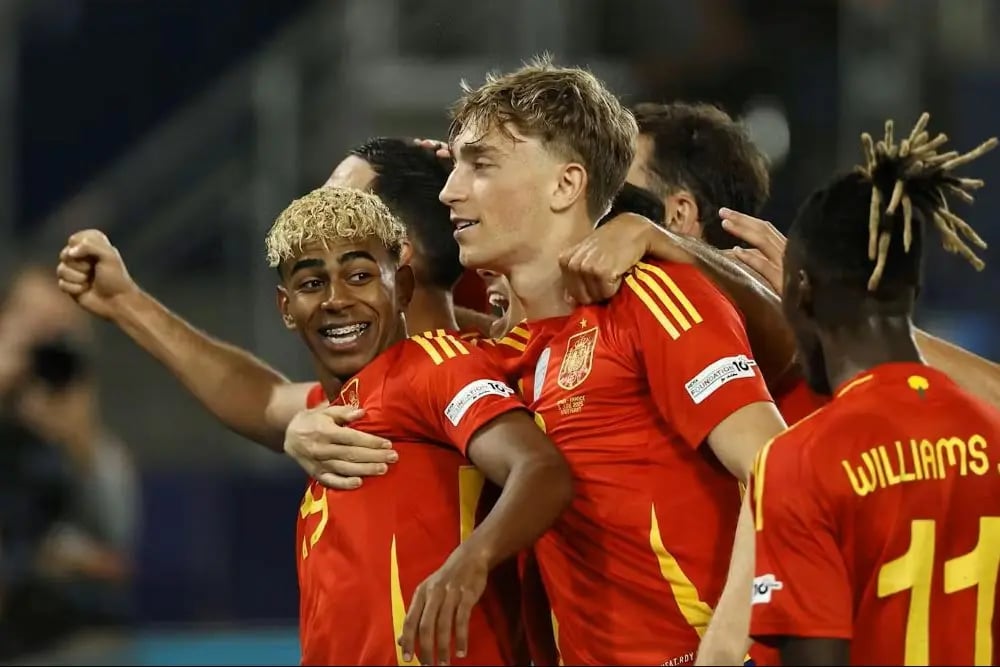
Luis de la Fuente’s success began in youth soccer
De la Fuente joined Spain’s national youth structure in 2013 and built his reputation by working with developing international players rather than through a high-profile career managing major European clubs.
He led Spain to the UEFA European Under-19 Championship in 2015 and then won the UEFA European Under-21 Championship in 2019. In 2021, he coached Spain to the silver medal at the postponed Tokyo 2020 Olympic Games before becoming senior national-team coach in December 2022. His senior side subsequently won the UEFA Nations League in 2023, UEFA Euro 2024 and the FIFA World Cup in 2026. (UEFA.com)
One clarification is important. De la Fuente did not win Olympic gold as head coach; his team earned silver in Tokyo after losing the final to Brazil. Olympic gold followed for Spain at Paris 2024 under another long-serving federation coach, Santi Denia. Denia spent 15 years working through Spain’s youth teams and won European titles at under-17 and under-19 level before leading the Olympic team to gold. The distinction actually strengthens the central point: Spain’s success is not based on one individual but on a federation capable of developing coaches and players through the same national pathway. (Olympics)
The consistency of the wider technical staff has also mattered. When de la Fuente formed his senior staff in 2022, the six leading appointments had previous experience within the Spanish federation. Their backgrounds included youth international coaching, physical preparation, goalkeeper development, analysis and psychology. When the staff was reorganised in 2025, the federation again prioritised internal knowledge and continuity across senior and youth teams.
That continuity gives players a shared language.
The terminology used to explain positioning, pressing, possession and transition does not need to change completely whenever a player moves between age groups. Individual coaches will naturally bring different ideas, but the wider football culture remains familiar. (ISSPF)
For coaches, this may be one of the most important lessons from Spain’s World Cup success. A player pathway is more effective when coach development and staff succession are planned alongside player development.
The players progressed through the same pathway
Spain’s senior team contains numerous players who developed under de la Fuente or within the federation’s connected youth structure.
Rodri, Mikel Merino and Unai Simón were members of the Spanish under-19 group that became European champions in 2015. De la Fuente later worked with players including Simón, Merino, Mikel Oyarzabal, Dani Olmo and Fabián Ruiz during the successful under-21 cycle. Many then progressed into the Olympic squad that won silver in Tokyo.
The Olympic group included Unai Simón, Marc Cucurella, Martín Zubimendi, Mikel Merino, Pedri, Oyarzabal and Olmo. These were not players introduced to international tournament football for the first time at senior level. They had already experienced short preparation periods, knockout matches, national expectation and the need to build relationships quickly with teammates from different clubs. (RFEBF)
The next generation followed a similar route. Pau Cubarsí and Álex Baena were members of the Spain squad that won Olympic gold in Paris in 2024 before becoming important members of the 2026 World Cup group. Eric García and Marc Pubill also moved through that Olympic environment and into de la Fuente’s senior plans.
Lamine Yamal represents a slightly different type of progression. Exceptional talents sometimes move more quickly than a conventional pathway suggests. Yet even when the individual is accelerated, the surrounding structure remains valuable. The player enters a team with established principles, experienced leaders and a coaching staff familiar with integrating young internationals.
Yamal and Cubarsí were both 19 when they played in the World Cup final. They became only the fourth and fifth teenagers to appear in a men’s World Cup final and finish on the winning side. Their performances demonstrate that youth development is not about delaying players until a predetermined age. It is about preparing them properly and promoting them when their technical, tactical, physical and psychological readiness justifies the opportunity.
The pathway therefore combines patience with courage.
Players are not selected only because they are young, and they are not excluded simply because they lack senior international experience. The federation develops them over time, observes them in age-group competition and creates opportunities when their qualities fit the senior game model.
Role clarity reduces the pressure of international soccer
National-team coaches have limited training time. Players arrive from different clubs, leagues, tactical systems and coaching cultures. A midfielder may operate as a single pivot for one club and as an advanced number eight for another. A full-back may be expected to overlap every week at club level but move inside when representing the national team.
Without clear references, international football can become a collection of talented individuals attempting to understand one another during matches. (ISSPF)
Spain’s pathway reduces that problem.
Many players have shared previous international camps and tournaments. They understand the standards surrounding national-team behaviour and have already experienced the pressure associated with representing Spain. More importantly, they recognise the core principles of the playing identity.
Role clarity does not mean every action is scripted. It means players understand the team’s intention.
The centre-backs know how the team wants to begin possession. The midfielders understand the importance of supporting underneath and beyond the ball. Wide players know when to maintain width and when to attack inside. The nearest players recognise their responsibilities immediately after possession is lost.
This creates freedom inside structure.
A player can make an individual decision because the positioning and likely movements of teammates are more predictable. The game model provides references without turning players into passive followers of instructions.
For youth coaches, this reinforces why development cannot be measured only through isolated technical ability. Players must learn to understand space, recognise game situations and communicate within a collective plan.
The ISSPF article on developing a game model for elite youth soccer explores how young players can be introduced progressively to tactical principles and positional responsibilities without removing creativity or decision-making.
Spain refined possession rather than simply protecting tradition
Spain’s style continues to be associated with possession, but the 2026 champions were not attempting to reproduce the team of 2010.
The national identity has evolved.
De la Fuente maintained the technical security, positional organisation and short-passing foundations traditionally associated with Spain. He also introduced greater verticality, more aggressive wide play and a willingness to attack space earlier when the opportunity appeared. FIFA described Spain before the tournament as combining its possession-based identity with increased directness and attacking freedom. (FIFA)
That balance is essential.
Possession should not be judged only by the number of passes completed. Its purpose is to manipulate the opponent, create positional advantages and improve the conditions from which the team can attack.
Spain frequently used circulation to move opponents horizontally before accelerating through a central combination, third-player movement or one-versus-one situation in a wide area. Yamal and Nico Williams could receive with space to attack because the earlier phases of possession had forced the opposition block to move.
The team also possessed multiple midfield profiles. Rodri could control the location and rhythm of possession. Fabián Ruiz, Merino, Pedri, Gavi, Zubimendi and Olmo offered different combinations of progression, movement, final-third creativity and defensive reaction.
The result was a game model capable of changing rhythm without losing identity.
Spain could circulate patiently against a deep block, attack more directly when opponents stepped forward or use the ball to reduce the momentum of the opposition. They were not required to attack at maximum speed every time they regained possession.
Their 2–0 semi-final victory over France included a long passing sequence before Pedro Porro’s goal, demonstrating how collective positioning and repeated movement could eventually open the decisive space. FIFA’s analysis of the champions highlighted how the sequence involved coordinated passing and movement throughout the team. (FIFA)
This is an important distinction for coaches. A possession model is not about keeping the ball for its own sake. It is about recognising when to attract pressure, when to move the opponent and when to accelerate towards goal.
Possession also supported Spain’s defence
Spain conceded only once during the entire tournament, in their 2–1 quarter-final win against Belgium.
That defensive record cannot be explained only by the performances of Simón or the centre-backs. It was connected to how the whole team used and reacted to possession.
When Spain had the ball, their structure provided security behind the attack. Players were positioned to protect central areas, control potential counter-attacking routes and challenge quickly if possession was lost.
This is often described as rest defence: the organisation maintained by the attacking team to manage the opponent’s transition threat.
Good rest defence allows more players to participate in attacks without leaving the team completely exposed. It requires appropriate distances between the deepest players, midfield protection and awareness of the opponent’s most dangerous outlets.
Spain then combined this structure with an immediate counter-press.
The first defensive action did not necessarily aim to win the ball instantly. It could delay the opponent, force a backward pass or prevent a direct attack while the wider team recovered its shape.
Possession, counter-pressing and defensive stability were therefore connected.
FIFA’s assessment of the champions noted that Spain did not merely dominate the ball; they also influenced what opponents were able to do when they gained possession. That is the difference between a team that passes attractively and a team that controls matches.
The tournament statistics reinforce that point. Spain combined a possession-control figure of approximately 61 per cent with seven clean sheets, only one concession and an unbeaten run that had extended to 38 matches by the end of the final. Since losing to Colombia in March 2024, de la Fuente’s team had recorded 29 wins and nine draws.
Did possession help Spain manage the North American heat?
The 2026 tournament presented significant environmental challenges. Matches were played during the North American summer across venues with different temperatures, humidity levels, travel demands and playing conditions. FIFA introduced three-minute hydration breaks midway through each half of every match, regardless of the weather at the individual venue.
Spain played group matches in Atlanta and Guadalajara before moving through knockout fixtures in Los Angeles, Dallas and New York/New Jersey.
It is reasonable to infer that their ability to control possession supported their management of these conditions, although there is no evidence that possession alone was adopted specifically as a heat strategy.
When a team keeps the ball effectively, it can regulate the tempo, reduce prolonged defensive chasing and limit the number of uncontrolled end-to-end transitions. Research in elite soccer has found that running, high-speed running and overall physical intensity can be greater during out-of-possession periods than when a team has the ball.
Hot conditions can reduce total and high-speed running output while increasing physiological strain. A team that can decide when the game accelerates may therefore be better placed to preserve concentration and physical resources across a long tournament.
However, possession should not be mistaken for physical rest.
Spain’s positional movements, support runs and counter-pressing still required substantial work. Players had to move continuously to create passing angles and then react aggressively after turnovers. The advantage was not that Spain avoided effort. It was that much of the effort occurred within an organised structure.
They were able to choose more of the moments in which the match became open.
This may have been particularly valuable in the final, where Spain remained patient for 106 minutes before creating the decisive goal. Argentina goalkeeper Emiliano Martínez made a World Cup final-record 12 saves, while Spain took nine of the first ten corners. The champions did not abandon their principles simply because the breakthrough was delayed.

What Spain’s success teaches youth-development coaches
Spain’s World Cup victory is a powerful case study in long-term development, but the lesson is not that every federation or academy should copy Spanish possession soccer.
The deeper lesson is alignment.
Spain connected talent identification, youth international competition, coach development, physical preparation, tactical education and senior-team opportunity.
Young players progressed through demanding but age-appropriate stages. Coaches were given time to understand the players. Successful youth principles were retained, assessed and refined rather than discarded whenever a new tournament began.
This is closely connected to long-term athletic development.
LTAD is not a promise that every talented child will become a professional. It is a structured approach to helping players develop the technical, tactical, physical and psychological qualities needed at each stage of maturation.
Early developers should not automatically be mistaken for the most talented players. Late developers should not be excluded because they currently lack physical strength or speed. Training must account for growth, maturation, movement competency, recovery and the changing demands placed on the player.
The ISSPF Certificate in Youth Soccer Athletic Development helps coaches understand these developmental building blocks. Its content includes youth testing, talent identification, strength development, maturation, nutrition, psychology, academy planning, training design and the transition from youth to first-team soccer. (ISSPF)
The related ISSPF article on Long-Term Athletic Development in Youth Soccer explains how participation, training, competition and recovery should be organised as a progressive pathway rather than as disconnected short-term programmes. (ISSPF)
Spain’s pathway shows what becomes possible when this thinking extends beyond one club or age group.
Game models must develop with the players
Long-term development must eventually connect to a clear way of playing.
A game model is not simply a formation. It describes the principles and behaviours the team wants to reproduce in possession, out of possession and during transitions.
Spain’s game model evolved as the players matured. Youth teams were not expected to perform with exactly the same tactical detail as the senior side, but they were introduced to shared ideas around technical security, positional awareness, collective support and responsibility with the ball.
As the players progressed, the complexity increased.
They learned to solve different pressing structures, manage game states, control transitions and adapt their roles without losing the wider identity.
This is why periodisation matters. Coaches must translate the game model into weekly training content. The principles cannot live only in presentations or tactical meetings. Players must repeatedly experience the relevant pictures, decisions and physical demands during practice.
The ISSPF Foundation Certificate in Soccer Coaching, Periodisation and Game Model Development is designed to help coaches build that connection. It provides a practical framework for structuring training weeks, aligning technical, tactical, physical and psychological work and designing sessions that transfer into match performance. (ISSPF)
Coaches can also explore ISSPF’s Game Model Development in Soccer and Tactics, Periodisation and Game Model Development resources for further insight into turning a playing philosophy into repeatable behaviours. (ISSPF)
TAKE THE COURSE NOW: Certificate in Youth Soccer Athletic Development
Spain’s World Cup was won years before the final
The defining moment of Spain’s 2026 World Cup will always be Ferran Torres’ extra-time goal against Argentina.
Yet the foundations of the victory were laid years earlier.
They were built when de la Fuente coached future senior internationals at under-19 level. They were strengthened through under-21 tournaments and Olympic football. They were protected through staff continuity and refined as the senior game became faster, more physical and tactically complex.
Spain did not preserve possession soccer as a museum piece. They modernised it.
They added width, penetration, counter-pressing, defensive security and the ability to attack more directly. They created room for exceptional young players while maintaining experienced leadership. They gave players clear roles without removing freedom.
Most importantly, they connected youth development to senior performance.
For coaches and practitioners, that may be the most important lesson of Spain’s second World Cup title.
A successful team can be built during one season. A sustainable football identity requires years of aligned coaching, patient development and a pathway that allows talented young players to become senior performers without having to relearn the game at every stage.
Spain became world champions in New York/New Jersey.
The development process that made it possible began long before they arrived.
Courses covered in this article
Foundation Certificate in Soccer Coaching, Periodisation & Game Model Development
Coach with a real framework – not a collection of drills – through a professional certification in Game Model Development and Periodisation, so every session has purpose, every week has structure, and training actually transfers to match performance.
View Details
Certificate in Youth Soccer Athletic Development (LTAD)
The Certificate in Youth Athletic Development in Soccer (LTAD) provides the latest training methods, research findings and detailed insights to help coaches prepare, train and maximise the long-term development of youth soccer players.
View Details
Did you enjoy this article?
Thanks for your feedback!